
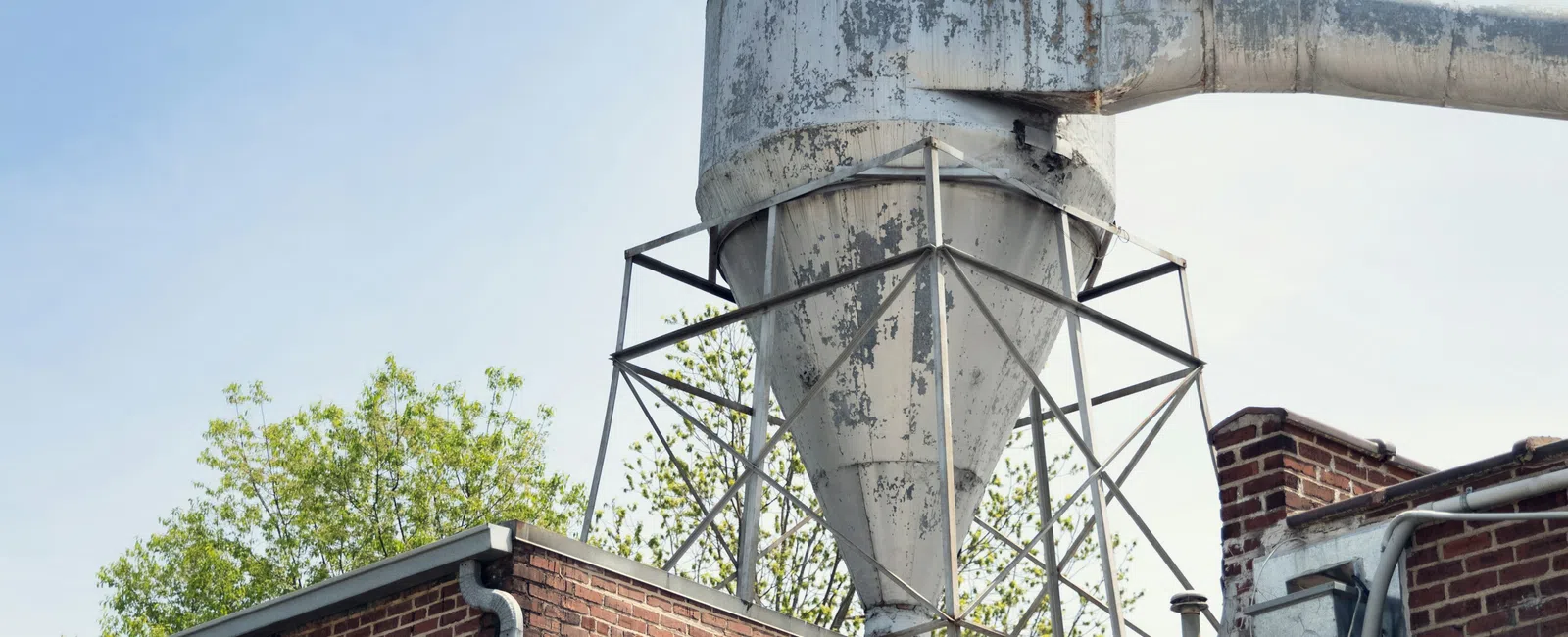
If your plant cuts, grinds, shreds, or converts material all day, you already know that dust and trim do not just disappear. They drift through the air, settle on equipment, load up filters, and quietly raise your fire and housekeeping risk. A cyclone separator is one of the oldest and most dependable answers to that problem.
What Is a Cyclone Separator?
A cyclone separator is a cone-shaped vessel that uses spinning air to separate solid particles from an airstream. No filter media. No moving parts. Just physics. Dust-laden air enters near the top, the shape forces it into a tight downward spiral, and centrifugal force throws the heavier particles outward against the wall. Those particles lose speed, slide down the cone, and drop into a collection hopper. Cleaner air reverses, rises through the center, and exits the top.
Because it works on motion rather than media, an industrial cyclone separator can handle heavy, abrasive, or high-temperature material that would shred a fabric filter in no time. That is why you see cyclones paired with shredders, grinders, trim systems, and pneumatic conveying systems in busy facilities.
How a Cyclone Separator Works, Step by Step
Strip away the engineering language, and the process is straightforward:
- Tangential Inlet. Dust-laden air enters near the top at an angle rather than head-on, which sets the air spinning instead of flowing straight through.
- The Vortex Forms. The cone shape squeezes the spinning air into a fast, tightening downward spiral, sometimes called the outer vortex.
- Centrifugal Separation. Heavier particles get flung outward to the wall, where friction and gravity pull them down. Lighter, cleaner air tends to stay toward the center.
- Material Drops Out. Separated solids fall into a hopper, bin, or airlock at the bottom for collection, baling, or transfer back into your process.
- Clean Air Returns. The cleaned air reverses into an inner vortex and exits through a central tube at the top, either to a secondary filter or back outside, depending on the application.
Why Recycling and Processing Plants Rely on Cyclones
In recycling and material recovery, the air rarely carries fine powder alone. It carries volume. A cyclone dust separator is built for exactly that kind of stream, capturing bulk material at the source before it spreads across the floor. Common targets include:
- Paper and corrugated trim from converting and box lines
- Wood fines and chips from pallet and lumber operations
- Plastic regrind and shavings from molding and converting
- Metal grinding and cutting dust in fabrication and scrap processing
In high-trim environments like printing and box shop operations, a cyclone is often the workhorse of the entire trim-and-scrap collection system. It keeps usable material together and moving toward your baler, rather than scattering it as waste.
Where a Cyclone Dust Collector Fits in a Multi-Stage System
Here is the part that facility teams miss most often. In most plants, a cyclone dust collector is not the finish line. It is the first stage. The cyclone handles the heavy lifting, dropping out coarse, bulky material, and then a downstream baghouse or cartridge collector captures the fine particulate that the cyclone lets through.
That two-stage setup pays off in ways that show up on your maintenance schedule:
- Downstream filters last longer because they see far less material
- Filter change frequency and cost both drop
- Airflow stays steadier with less static pressure buildup
- The system handles surges and high dust loads without choking
Strengths and Limits of Cyclonic Separation
Cyclones earn their place for good reasons. They are rugged, low-maintenance, and have no filters or motors to wear out, so they hold up in harsh, abrasive, or hot conditions where other equipment struggles.
They are not magic, though. A cyclone alone will not pull out the finest dust, and it will not meet strict emission limits on its own. Sizing matters enormously, and a unit that is too large or too small for your airflow will underperform no matter how well it is built. Effective dust control almost always means matching the cyclone to the rest of the system rather than dropping one in and hoping for the best.
What Affects Cyclone Performance
If you are weighing a cyclone for your facility, these are the variables that decide whether it works well or fights you. Getting them right is engineering work, not guesswork, which is also why dust control matters on the plant floor far beyond simple housekeeping:
- Airflow volume and inlet velocity
- Particle size, shape, and density of your material
- Inlet and outlet geometry and body diameter
- System pressure drop and ductwork balance
- How the cyclone integrates with conveying, collection, and downstream filtration
When to Bring in a Cyclone System Specialist
A cyclone is simple in concept and unforgiving in execution. The difference between a system that quietly works for years and one that clogs, leaks, or starves your downstream filters usually comes down to design and installation. That is where a partner with real plant experience matters. Crigler Enterprises has spent more than 50 years designing, installing, and servicing air handling and separation systems, and as an authorized distributor across Georgia, Florida, and Alabama, our system design and installation team sizes each setup to your material stream, footprint, and airflow rather than to a catalog spec.
We build separators and air systems as part of full-custom waste-handling systems, from single rooftop separators to dual-separator and edge-trim configurations, and we back every installation with the largest service fleet in the Southeast.
Talk to Crigler About Your Air Handling System
Not sure whether a cyclone separator belongs in your operation, or how it should tie into your existing dust control and baling equipment? Let our team walk through your application and recommend the right configuration. Call us today to request a consultation, or contact our service team to get started on a cleaner, safer, more efficient plant floor.


