
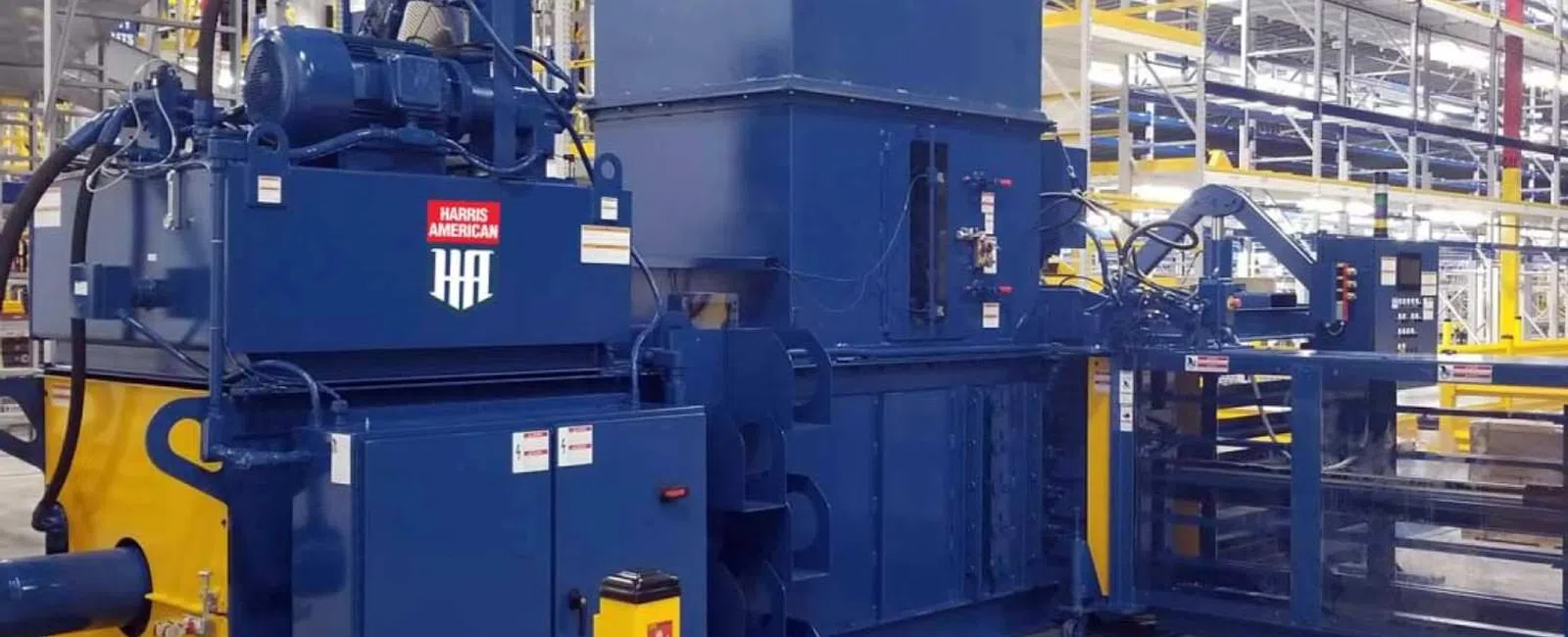
Harris American
builds more baler families than most facilities will ever need, which is useful
once you know the range and confusing before you do. A buyer looking at a
Badger, a Titan and a WS Series for the first time is usually trying to work
out whether these are three answers to the same question or three answers to
different ones.
They are
different questions. Every Harris baler in the range sorts along three axes:
how the bale is tied, how the material is ejected, and how much material moves
through in a shift. Work out where you sit on those three and the shortlist
writes itself.
Where Harris Sits in the Market
Harris has been
building baling and compaction equipment for decades and manufactures in
Cordele, Georgia. For a facility anywhere in the Southeast that matters more
than it sounds, and the reason is covered further down.
The line spans
horizontal balers, two-ram balers, and closed-door units, all of which sit in
the Crigler baler lineup.
What follows is how the Harris families differ in purpose. Actual capacities,
bale dimensions, and throughput figures come from the spec sheet for the
configuration you are quoted, because all of them are built in multiple sizes.
The Horizontal Families: DC, PAC and WS
Horizontal
balers take material in through a top opening, compress it along a horizontal
axis, and push the finished bale out the end. They suit continuous feeding,
which means they pair naturally with a conveyor rather than a forklift and a
floor pile.
Harris runs
several horizontal families rather than one, because the demands differ sharply
between a print shop producing steady clean trim and a transfer station taking
mixed loads all day. The practical questions that separate them are throughput
per hour, the size and toughness of what goes in the opening, and whether the
machine ties bales automatically. Getting that first one right is what matching
baler size to your waste volume is really about, and it is the decision
that is most expensive to revisit later.
The Two-Ram Line: Badger, Centurion and Gorilla
A two-ram baler
uses one ram to compress and a second to eject, which is what lets it handle
material a single-ram machine struggles with. The compression stroke doesn't have to double as the ejection stroke, so the machine can build denser bales from awkward material without fighting itself.
That design is
why two-ram units end up in operations running non-ferrous metal, mixed rigid
material, and anything that does not behave like flat corrugated. Crigler
already covers why an
operation would specify two-ram over a standard baler, so the question here
is narrower: Badger, Centurion, or Gorilla. They sit at different points on the
scale, and the honest answer is that the choice follows tonnage and material
mix rather than preference.
The Titan Closed-Door Series
A closed-door baler compresses against a door at the end of the chamber, producing a tightly formed bale but requiring an operator to open the door and tie each one. That trade between bale quality and labor is the whole decision. It is the same fork every buyer hits when choosing between auto-tie and closed-door balers, and the answer depends more on your staffing than on your tonnage.
Titan units make sense where volume is real but not constant, where floor space is tighter than a full auto-tie line needs, or where the operation would rather spend labor than capital. They are a common first horizontal baler for a facility outgrowing a vertical machine.
What the Authorized Distributor Relationship Covers
Buying Harris
equipment through an authorized distributor rather than a broker or a
marketplace listing changes three things, and none of them are visible on the
day of purchase.
•
Parts come through a supported channel. An authorized
distributor stocks for the brands it carries rather than sourcing each part
after the machine is already down.
•
Warranty stays intact. Who performs service during the
warranty period can carry conditions, and going outside the authorized channel
is where that gets complicated.
•
Configuration is checked before it ships. A distributor
that installs these machines catches the mismatch between a quoted model and
your actual door height, power supply, or floor layout while it is still a
drawing.
That last point
is why the specification conversation and the system design and
installation conversation are really one conversation. A baler that fits
the tonnage but not the building is still the wrong baler.
Why a Georgia Manufacturer and a Georgia Distributor Matter Together
Harris
manufactures in Cordele, Georgia. Crigler operates out of Mableton, Georgia,
and holds the Harris distributorship for Georgia, Florida and Alabama.
Two things
follow from that. Parts move a short distance rather than across the country,
which shortens the gap between diagnosing a failure and fixing it. And when a
machine needs something non-standard, the distance between the people who built
it and the people servicing it is a few hours rather than a supply chain. That
is the practical end of baler repair and
parts support, and it is the part that is hard to appreciate until the day
it matters.
What the Model Name Does Not Tell You
Each of these
families is built in multiple sizes, so a family name narrows the field without
settling it. Two facilities can both be quoted the same series and end up with
machines of noticeably different capacity, chamber size, and motor rating.
That is why a
model name is a starting point rather than an answer, and why the spec sheet
matters more than the badge. It is also why controls are worth raising early:
an older machine in any of these families can often be brought forward with a PLC upgrade rather than replaced
outright, which changes the buying decision entirely.
Matching a Harris Model to Your Operation
Five questions
settle most of this before anyone quotes anything, and they are the same five
that decide which Harris baler ends up on the floor.
•
What material, and is it consistent? Clean corrugated
and mixed rigid material point at different machines.
•
How much per shift, at peak rather than on average?
Equipment sized to the average is undersized eleven months a year.
•
How is it fed? A conveyor-fed line and a forklift-fed
floor pile lead to different configurations.
•
How much operator time is available? That is the
auto-tie versus closed-door question in its practical form.
•
Where is it going, and what are the door height,
ceiling clearance, and power supply in that spot?
Facilities that
already know their answers often find a used or refurbished unit in the current
equipment inventory fits before a new build is necessary, particularly on
the horizontal side where Harris machines hold up for decades.
Talk to the Harris Distributor for Georgia, Florida and Alabama
Crigler
Enterprises has sold, installed, and serviced recycling equipment since 1972 and is the authorized Harris American distributor across Georgia, Florida, and
Alabama. We service equipment regardless of where it was bought, and we stock
parts for everything we sell.
We are licensed
and bonded, and we run the largest service fleet in the Southeast behind
everything we sell.
Call
us to get started today, tell us what you are baling and how much moves in a shift, and we will tell you which Harris family fits and which one
is more machine than you need.


