
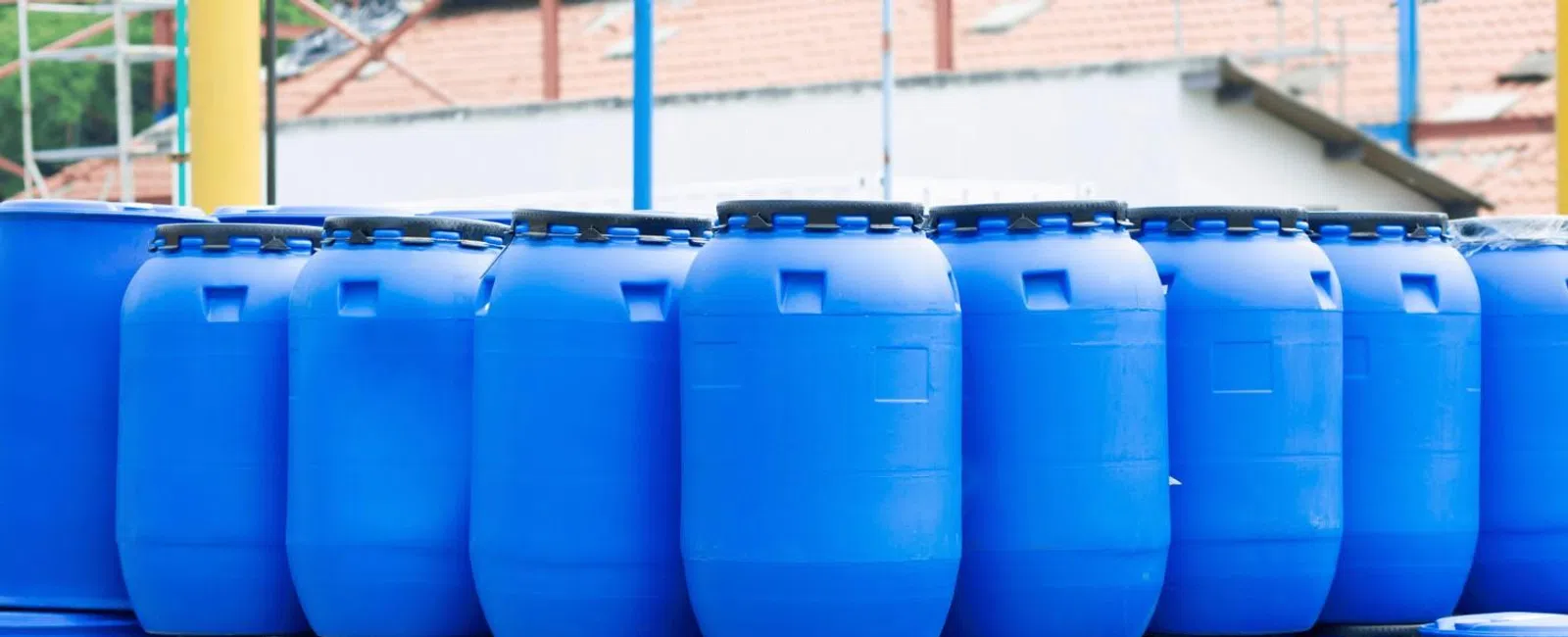
Why Empty Totes and Drums Become a Problem
An IBC tote is mostly air. A standard 275- or 330-gallon tote is a high-density polyethylene bottle sitting inside a galvanized steel cage on a pallet, and once empty, it holds nothing but space. Stack a few dozen, and you have surrendered a chunk of your yard. Load them on a truck, and you are paying to haul mostly air, because uncompressed totes and 55-gallon drums have terrible density.
The costs stack up in ways that rarely show on a single line item:
- Yard and warehouse space tied up by empties instead of product
- Hauling charges driven by volume rather than weight
- Labor spent moving, staging, and loading bulky containers
- Liability exposure when containers hold regulated material
Meanwhile, the HDPE in those containers is a genuinely valuable resin. It only becomes worth something once it is small, clean, and dense enough for a buyer to want it.
What IBC Tote Recycling Actually Involves
IBC container recycling is not one process. It is a short chain, and the sequence matters. The cage and pallet are separated and routed out through their own channel. The HDPE bottle is what you are really after. Reduced to flake or chip, that plastic can be sold into a resin market instead of paying its way into a landfill.
Plastic drum recycling follows the same logic on a smaller scale. A 55-gallon poly drum is a thick-walled HDPE shell that occupies far more space than the resin inside it justifies. Size reduction is what closes the gap between what the container costs you and what the material is worth.
If your operation already handles other resin streams, the approach will feel familiar. The same size-reduction principles that apply when you shred plastic waste as film, rigids, and purgings carry straight over to totes and drums.
How Shredding Changes the Economics
Instead of paying to move empty containers, you reduce them on site and move material. A single-shaft shredder tears a tote bottle or drum down to a uniform particle size in one pass. What was a truckload of hollow shells becomes a fraction of the volume, and what was a cost becomes a commodity you can sell or feed back into your own process.
The knock-on effects tend to matter as much as the resin revenue:
- Fewer outbound trips, because you are hauling density instead of air
- Yard space returned to production and staging
- A defensible diversion number for sustainability reporting
- Control over your own schedule rather than waiting for a pickup
For plastics processors and recyclers that take totes and drums as feedstock, the calculation is even more straightforward. Throughput is the whole business, and a machine that cannot keep up with incoming volume becomes the bottleneck for everything downstream.
Choosing a Shredder for Totes and Drums
Not all shredding is the same, and matching the machine to the material is where operations get it right or wrong. HDPE totes and drums are thick, tough, and springy, which punishes equipment that was specified for lighter material. Single-shaft shredders handle this class of plastic well, and low-speed, high-torque machines are built for the abuse that bulky, rigid containers deliver.
A few factors that shape the right specification:
- Material mix, since totes, drums, and pallets each behave differently in a rotor
- Volume and required throughput, measured against your actual container counts
- Output size, which depends on what your buyer or your downstream process needs
- Whether steel cages arrive attached, which changes the entire infeed approach
- Footprint, power, and how the unit integrates with existing conveyors
Crigler Enterprises distributes industrial shredders from Weima, American Pulverizer, Vecoplan, and BloApCo, including single-shaft and low-speed, high-torque machines suited to rigid plastics. Getting the specification right the first time is the difference between a machine that runs for decades and one that fights you every shift.
The Contamination Question You Cannot Skip
Whatever is in the container determines what you can do with it. A tote that held food-grade syrup and a tote that held an industrial solvent are not made of the same material, and they do not follow the same path. Residue affects whether the plastic can be sold, what handling your team needs, and which regulations apply to your facility.
This is a conversation to have with a specialist before you buy anything. It is not a step to improvise around, and it is not a place for workarounds. Get the material profile right, and the equipment decision becomes straightforward.
Build the Right System for Your Waste Stream
Shredding rarely stands alone. Most plants that get real value out of IBC tote recycling end up with a small system: an infeed conveyor, a shredder, and often baling equipment or a separation step to prepare the material for market. Designing that flow around your building, volume, and material is exactly what a custom waste-handling system is for, and our team handles the design and installation end-to-end.
If the empties are stacking up faster than you can move them, let us look at your material and your volume and tell you honestly what makes sense. Call us today or reach out via our website to speak with a system specialist. Fifty years of experience in recycling equipment and the largest service fleet in the Southeast stand behind every system we install.


